How Do I Size the Solar Water Pumping for Irrigation Purposes?
Date
Category
Product

Sizing a solar water pumping system for irrigation is critical to meeting crop water needs efficiently—whether for small farms or large plantations. The key lies in matching the system to your water demand, well conditions, and local sunlight. Below is a concise, actionable guide for growers.
1. Calculate Daily Irrigation Water Demand
Start with the core requirement: how much water your crops need daily. Use this simple formula:
Daily water demand (L) = Irrigation area (m²) × Crop daily water consumption (L/m²)
Crop consumption varies (e.g., 3-5L/m² for vegetables, 1-2L/m² for grains; adjust based on crop type and growth stage).
Example: A 1000m² vegetable field needs 4L/m²/day = 4000L (4m³) daily.
2. Match Pump Power to Well Depth & Flow Rate
The solar irrigation pump’s power (HP/kW) and performance depend on two key factors:
Well depth (head): Deeper wells require pumps with higher lift capacity (e.g., a 50m deep well needs a pump with ≥60m head to account for pressure loss).
Required flow rate: The pump’s hourly flow (L/h) must meet daily demand within available sunlight hours. For example, if sunlight allows 6 hours of pumping, the pump needs a flow rate of 4000L ÷ 6h ≈ 667L/h.
Choose a submersible solar pump or off-grid water well pump with power (e.g., 0.5-2.2kW) matching the calculated head and flow.
3. Size Solar Panels with Safety Margin
Solar panel wattage must cover the pump’s energy needs plus a buffer for cloudy weather:
Total panel power (W) = Pump power (W) × 1.3-1.5 (safety margin for efficiency loss and cloudy days).
Example: A 1kW solar irrigation pump needs 1000W × 1.4 = 1400W total panel power (e.g., 4×350W panels).
Prioritize panels with optimal Vmp (maximum power voltage) matching the pump controller’s range to maximize energy conversion.
4. Optimize Panel Configuration & Compatibility
Series/parallel connection: For 24V/48V pumps, connect panels in series to reach the required voltage, or parallel to boost current (follow the controller’s guidelines).
Off-grid adaptability: If no grid backup, add a battery bank (optional) to store excess energy for evening/overcast irrigation.
Efficiency first: Choose high-conversion (≥22%) panels and energy-saving BLDC motor pumps to reduce panel quantity and installation costs.
In summary, sizing a solar irrigation pumping system involves three core steps: calculating daily water demand, matching pump power to well conditions, and sizing panels with a safety margin. By aligning these factors, you’ll get a reliable, efficient system that meets your crops’ irrigation needs while maximizing solar energy use.
Relevant Models

4SPW3-8P 1200W
1200W/1.61Hp 2.0 Inches Automatic Solar Submersible Water Pump Controller for Irrigation

3SPN1-12P
100m Head Solar Pump for Irrigation and Deep Well Use

3SPN2-11
1200W / 1.61Hp 1.25 Inches Automatic Solar Submersible Water Pump Control for Irrigation
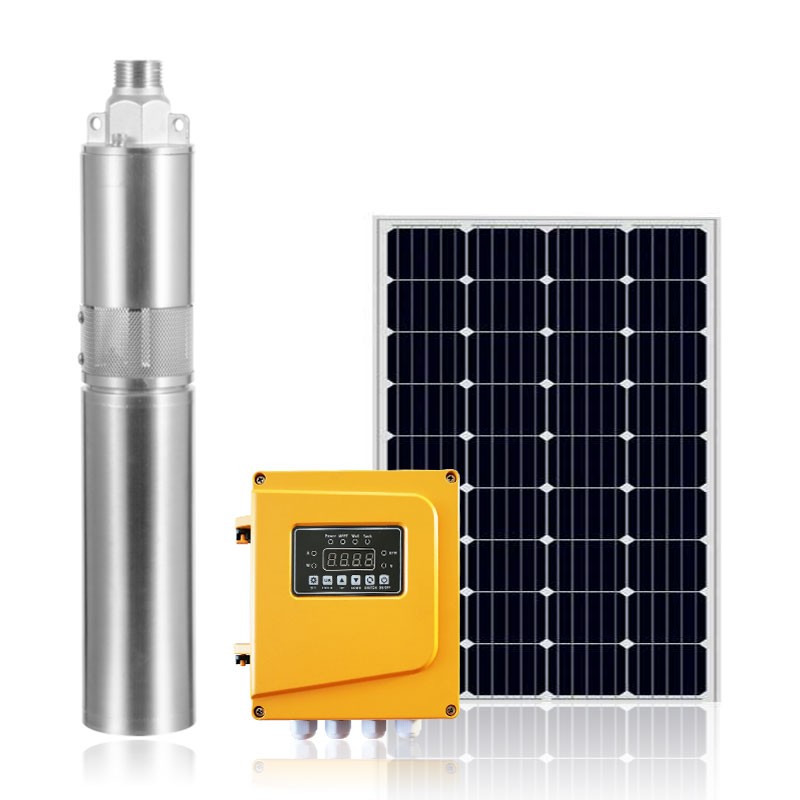
3SPWF 1.5-120
0.75HP 1 Inches DC Solar DC Solar Powered Deep Well Irrigation Pump
More Newscases